Meet Our Founders
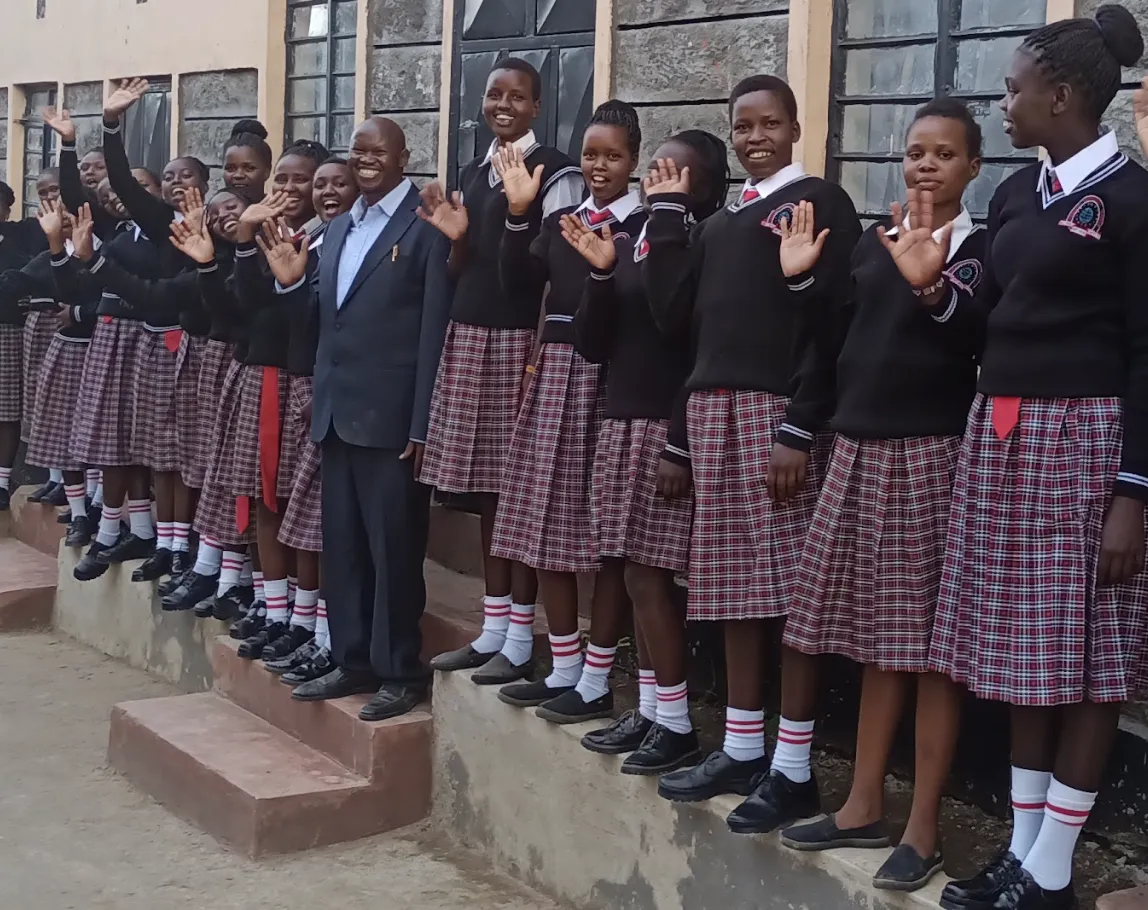
Patrick Ngigi: Rescuing Girls from the Knife and the Altar
How a Kenyan headteacher rescues girls from early child marriage and female genital
mutilation, and built a movement.
Author: Chaznane Fidahoussen
In 1997, a young schoolgirl walked into head teacher Patrick Ngigi’s office. “I’m getting married off. Can you help me?” she asked.
At the time, Patrick had just taken up his post as a headteacher in Narok, in Kenya’s Maasai region. For years, he had seen girls vanish from his classroom into forced child marriages, and the brutal practice of female genital mutilation was normalised as a coming-of-age rite. On this day, he rescued his first girl and continued.
By 2023, more than 230 million girls and women endured female genital mutilation (FGM) on a global scale. FGM comprises all procedures that involve partial or total removal of female genitalia or other injury to the genital organs for non-medical reasons. The practice has no health benefits and often results in severe long-term bleeding and complications in childbirth. These traditional communities often treat FGM as a social or cultural obligation and a preparation for adulthood and marriage. Some believe this practice has religious support, although no scriptures endorse it.
UNICEF defines early child marriage (ECM) as any formal or informal union between a child under age 18 and an adult or other child. Despite the global decline in this practice over the years, the issue remains prominent, with one in five girls married during their childhood. Various global crises today threaten to reverse this progress.
Against the backdrop of deepening global challenges, Patrick found a way to take meaningful action locally. “Being a head teacher finally gave me power,” Patrick said on Zoom, speaking from the safehouse he built for rescued girls. “As a teacher, you just reported things. The head teachers often did nothing about this; some even married the girls themselves.”
Patrick sheltered the first girl he rescued in his mother’s home. “I wasn’t married then,” he explained in the interview, “so there was no one else who could take care of her except my mother.” A pastor friend’s family took in the second girl rescued. Within weeks, more girls came seeking help, each desperate to escape. Patrick eventually became the founder of Mission With a Vision (MWAV), an organisation that has rescued over 3,500 girls and young women from FGM and ECM across Kenya’s Maasai region. “I started alone,” he said. “But the need kept growing. So I grew with it.” Almost 30 years later, eradicating FGM and ECM became a movement that shifted generational mindsets in the area.
Rescue missions, in Patrick’s world, are dangerous and unpredictable. “One father said he would kill me,” Patrick acknowledged when recalling an early case. “We are threatened every single day. For every girl we rescue, it’s a risk.” A low staff number and vehicles prone to breaking down during a rescue also add to the challenge. “Sometimes our rescue van breaks down mid-operation, you go in to rescue a girl, and you don’t know if you’ll make it out. But you make yourself courageous. Rescuing girls from FGM and ECM is not for the faint-hearted.” Yet, for the last 28 years, he continued.
In 2004, Patrick and a British family, the Keatons, raised enough money to build a safehouse meant for 12 girls. However, by 2007, 33 girls lived there, an overload compared to before. Thankfully, with donor support, a second safehouse was built by 2014. The reliance on international donors, however, came with strings attached. “There was a sponsor who said, ‘Once you have the money, you have the power.’ And I felt bad, I believe that if we are coming to the table, we come as equals. Not to worship donors like gods of money.” In 2023, one of MWAV’s longest-standing sponsors walked away after a decade and said, “In America, an agreement is an agreement.” Patrick shook his head. “So the honeymoon was over.”
When Josephine married Patrick in 2007, she didn’t just gain a husband; she also inherited 33 daughters. “She became part of a much larger family,” he laughed. “Imagine saying, ‘I want to marry you,’ and hearing, ‘By the way, I have 33 kids.” Josephine leads vocational training, teaching girls to sew and sell school uniforms.
This work expanded beyond rescue. MWAV offers medical care, trauma counselling, vocational training, and education. Girls who arrive with no formal schooling learn to read, speak Swahili, and join schools. Older girls train in hair dressing, tailoring, and other vocations. Teen mothers are supported, too, many of whom had been kicked out of their homes due to pregnancy. “We don’t just protect them,” Patrick said. “We equip them. We make sure they thrive.”
When possible, MWAV helps girls reunite with families through mediation. The organisation works with chiefs, elders, and religious leaders to arrange reintegration under strict agreements that guarantee safety and education. “Reconciliation takes time,” he said. “Sometimes we go through village elders or local chiefs. It can take three to four years before a family agrees to meet us. But we’ve never failed to reconcile a girl in 27 years. According to him, not a single case has failed. At first, we’re enemies. But when they see their daughters graduate, get a job and build them a house, they suddenly want them to go to school.” MWAV is committed to supporting every girl’s education until their completion.
When asked what success looks like, Patrick didn’t mention numbers. He mentioned memories. “One of our girls became a nurse. Another built her parents a beautiful house. When I saw them, I knew their daughters would never face FGM.”
He said his greatest achievement was the cultural shift, changing the minds of the region. “In 1997, the school I worked for had 33 girls. Now? Over 600. Girls were there before; they just weren’t taken to school.”
Still, challenges persist despite the victories. “The biggest problem now is not ECM, it’s FGM,” he said. “Girls still think they need to undergo it to be seen as women. It’s about acceptance. Peer pressure. We need a generational mind shift.” As a result, Patrick went to classrooms to push this change, speaking directly to boys and girls about autonomy. He also believes that the solutions to FGM are not top-down. “The president once said FGM must be ended by 2022. You can’t give orders for a cultural thing to end. You need to win hearts. You need to talk.”
Today, MWAV’s biggest obstacle is financial uncertainty. “The biggest challenge is fundraising,” Patrick explained. “If you don’t raise money for food or schooling, the girls won’t eat or go to school. We must do everything for them, like parents.” Their staff number is low. “We are running a big project with a small staff,” he admits. Their bookkeeping is also outdated; it happens by hand. “We are looking to be self-sufficient,” he said. “We started farming. We are thinking of small businesses to support the girls’ meals and schooling.”
Patrick’s mission remains clear: no FGM, no child marriage, and a society where the girls are not just safe, but educated, supported, and celebrated.
Before ending the interview, he was asked what it would take to win in the long term. He expressed, “In the next five years, we are looking to be self-sufficient. We’re building small businesses to support meals and schooling. We want to move beyond relying on donors.” Patrick also emphazised the importance of addressing FGM and ECM. “A mind shift”, he says. “The money helps. But the power? It’s in the network we built and in the girls who made it. This is their movement, not mine.”
Today, many of the girls rescued by MWAV now lead the fight themselves. They returned to their communities as role models and challenged those harmful customs, which empowered other girls to speak up.
“The ones who make it, they are our best story. They are the reason we fight.”


© 2025 In collaboration with The New School